
In the hospitality industry, every operational decision directly affects your bottom line, staff labor hours, and guest satisfaction scores. While bedding choices might seem straightforward to the average consumer, hotel managers, executive housekeepers, and procurement officers across Canada know that choosing between fitted sheets and flat sheets is a high-stakes operational debate.
When evaluating fitted vs. flat sheet performance for a commercial property, the right choice isn’t just about how the bed looks when freshly turned down. It comes down to commercial laundering machinery compatibility, laundry turnaround times, shelf-stacking density, and total cost of ownership (TCO).
Whether you are managing a boutique hotel in Banff, a high-volume resort in Niagara, or a chain of commercial properties across Toronto, this guide breaks down the operational pros and cons of flat sheet vs. fitted sheet strategies to help you make the best procurement decision for your property.
Key Takeaways:
- Flat sheets outlast fitted sheets by eliminating high-heat elastic failure in laundering.
- Industrial ironers and folding machines require flat sheets for maximum operational speed.
- Flat sheets optimize storage space and inventory density by roughly up to 40%.
What is the Difference Between Flat Sheet vs. Fitted Sheet?
Before diving into commercial logistics, it is helpful to establish how these two core bedding components differ in design and function:
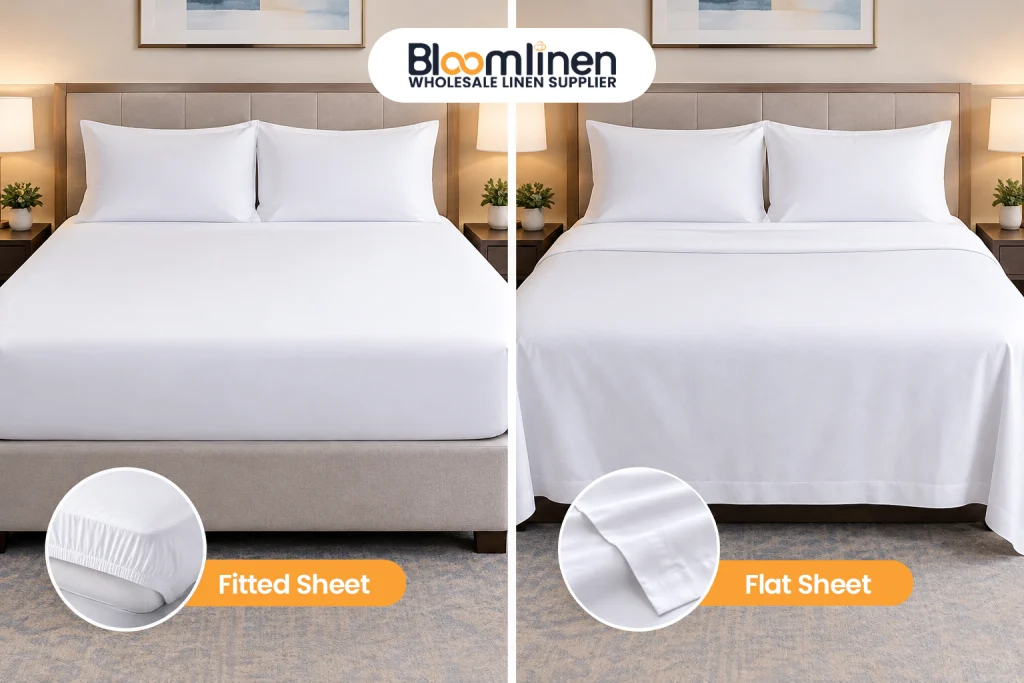
- Fitted Sheets: Engineered with elasticated corners or a fully elasticized perimeter designed to hug the contours of a mattress. They provide a smooth, tight bottom surface without requiring manual folding techniques.
- Flat Sheets: Versatile, rectangular pieces of finished fabric with tailored hems. They are laid flat over the mattress or tucked beneath it using traditional “hospital corners.”
Quick Comparison: Fitted vs. Flat Sheets for Hospitality
|
Operational Metric |
Fitted Sheet Performance |
Flat Sheet |
|
Housekeeping Bed-Making Speed |
Faster Basic Fit |
Requires Skill |
|
Commercial Ironer Compatibility |
Poor |
Excellent |
|
Laundry Lifecycle |
Shorter |
Extended |
|
Cart Stacking |
Bulky |
Compact |
|
Guest Comfort |
Smooth Fit |
Traditional Luxury |
Are Fitted Sheets or Flat Sheets Better for Commercial Properties?
From a purely residential perspective, consumers often prefer fitted sheets because they stay in place on a single bed without tucking. However, in a commercial hotel setting, neither sheet is universally better. The optimal choice depends on your property’s laundry infrastructure, bed-making protocols, and inventory management practices.
1. Housekeeping Bed-Making Speed
Housekeeping labor represents one of the largest ongoing operational costs for Canadian hospitality properties. Evaluating how flat vs. fitted sheet selections impact room turn times is critical.

A- Fitted Sheets on the Floor
Fitted sheets offer an intuitive, quick installation for housekeeping staff. A housekeeper can secure all four elasticated corners around a standard mattress in seconds without needing specialized folding training.
However, fitted sheets introduce challenges when dealing with varying mattress profiles:
- Pocket Depth Constraints: Canadian hotels increasingly utilize thick pillow-top mattresses, plush toppers, or waterproof encasements. If a fitted sheet’s pocket depth is too shallow, housekeepers waste valuable time fighting tight elastic corners.
- Physical Strain: Repeatedly lifting heavy, high-density commercial mattresses to snap elastic corners underneath can increase physical fatigue for room attendants over a full shift.
B- Flat Sheets & The Triple Sheeting Strategy
While tucking a flat bed sheet vs. fitted sheet requires training staff in crisp “hospital corner” folding techniques, flat sheets offer unparalleled operational flexibility through Triple Sheeting.
Why Do Hotels Use Flat Sheets Instead of Fitted?
- The Triple Sheeting Advantage: High-end Canadian properties use three flat sheets to make a single bed: a bottom flat sheet (tucked securely), a middle flat sheet, and a top decorative flat sheet wrapping a thermal blanket or insert. This completely eliminates the need for heavy, difficult-to-wash duvets or comforters.
- Simplified Linen Inventory: By using flat sheets for both the top and bottom layers, properties can order a single SKU in bulk, simplifying inventory tracking and lowering per-unit bulk purchasing costs.
Why do people not use flat sheets anymore at home?
Many retail consumers skip flat sheets at home to simplify personal bed-making routines. However, commercial hotel environments rely on flat sheets because they create a clean, hygienic physical barrier between the guest and heavy top blankets, while standing up to high-temperature commercial sanitation cycles.
2. Commercial Ironer Compatibility
The most significant divergence between flat sheets vs. fitted sheets occurs behind the scenes in On-Premises Laundries (OPL) and commercial laundry facilities.
A- Industrial Ironer Compatibility
Commercial laundries utilize high-speed flatwork ironers (rotary mangles) to dry, press, and sanitize linens simultaneously.
- Flat Sheets: 100% compatible with flatwork ironers. A flat sheet feeds smoothly through industrial rollers at high speeds, emerging crisp, wrinkle-free, and ready for automated folding equipment.
- Fitted Sheets: The gathered, elasticized corners of fitted sheets trap moisture, bunch up in rollers, and risk snagging or jamming high-speed commercial ironers and automated folder lines. As a result, fitted sheets often require manual handling, line drying, or extra tumble drying.
B- Inventory Density & Storage
Storage efficiency is a key factor in housekeeping operations:
- Flat Sheets: Stack into ultra-compact, perfectly flat rectangular piles. This maximizes storage density on housekeeping carts and linen room shelves, allowing staff to restock faster.
- Fitted Sheets: Due to elastic gathered edges, fitted sheets create bulky, uneven stacks that consume up to 30% to 40% more shelf space and complicate quick visual inventory counts.

3. Laundry Lifecycle
Evaluating flat sheet vs. fitted sheet pros and cons requires looking beyond the initial purchase price to examine long-term wear and replacement cycles.
A- Elastic Degradation & High-Heat Sanitation
Commercial laundering in Canada demands high-temperature sanitizing wash cycles, industrial bleach or oxygen detergents, and high-heat tumble drying—especially during peak winter guest turnarounds.
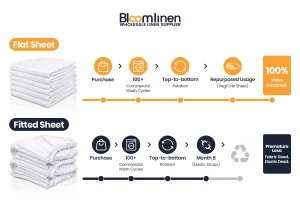
- Fitted Sheet Elastic Fatigue: Rubber and synthetic elastane components degrade rapidly under harsh commercial wash chemicals and heat. Once the elastic snaps or loses tension, the fitted sheet loses its functionality and must be retired early—even if the main fabric weave remains pristine.
- Flat Sheet Durability: With no elastic or moving parts, flat sheets feature a single, continuous fabric weave. Physical wear is distributed evenly across the surface.
B- Rotation and Repurposing
When a flat sheet shows minor localized wear, housekeepers can rotate it (top-to-bottom) or downgrade it for secondary uses (such as baby crib under-layers or cleaning rags). A fitted sheet with failed elastic, by contrast, has zero remaining commercial utility.
Canadian Hospitality Considerations
Selecting the right commercial linens requires factoring in unique regional needs across Canada:
- Varied Mattress Configurations: Canadian boutique hotels, ski resorts, and healthcare facilities frequently utilize thermal mattress pads and waterproof encasements to protect beds against snow, mud, and moisture. Flat sheets easily adapt to varying total mattress depths without requiring multiple fitted sheet pocket sizes.
- Seasonal Humidity & Drying Cycles: During wet winter and spring seasons across Canadian provinces, laundering throughput is critical. Flat sheets dry faster in industrial tumble dryers and pass immediately into pressing equipment, optimizing energy and fuel usage for your laundry operations.
Procurement Recommendation
When choosing between fitted vs. flat bed sheets for your property, align your selection with your operational structure:
- Choose Flat Sheets if: You run an On-Premises Laundry (OPL) with flatwork ironers, contract with an off-site commercial laundry service, utilize triple sheeting, or want to maximize the lifespan and ROI of your linen inventory.
- Choose Fitted Sheets if: You operate a small bed & breakfast, boutique inn, or short-term rental property where manual bed-making speed by a small team outweighs the need for industrial flatwork pressing.
Commercial Linen Procurement Checklist
When purchasing commercial bed sheets for Canadian hospitality properties, ensure you select fabrics built for high-volume laundering:
- Thread Count: T-200 to T-250 offer the optimal balance of softness, crisp texture, and commercial durability.
- Fabric Blend: High-durability Cotton-Poly blends (e.g., 60% cotton / 40% polyester) combine natural breathability with crease resistance and fast drying times.
- Hem Indicators: Look for color-coded hem threads or size labels to help housekeeping staff identify sheet sizes quickly in dark laundry rooms.
What Bedsheets Bloom Linen Offers?
To suit every property’s specific laundry setup and budget, Bloom Linen supplies a comprehensive wholesale collection available in both flat and fitted sheet styles. For properties seeking high-durability, wrinkle-resistant options that withstand frequent commercial laundering, our poly-cotton blend lineup includes the T-180 Economy Bedsheets, T-200 Premium Bedsheets, T-200 Premium Color Bedsheets, T-250 Luxury Plain Bed Sheets, and T-250 Luxury Stripe Bedsheets. For properties prioritizing ultra-fast drying times, exceptional stain resistance, and lightweight housekeeping management, we also offer Premium Microfiber Sheets in both flat and fitted options.
Conclusion
Choosing between fitted and flat sheets ultimately comes down to aligning your bedding choices with your property’s operational setup, laundry equipment, and guest experience goals. While fitted sheets offer quick manual application for smaller inns and rentals, flat sheets remain the gold standard for high-volume Canadian hotels seeking maximum laundering throughput, triple-sheeting versatility, and a lower total cost of ownership. By pairing the right sheet style with commercial-grade fabrics engineered for industrial washing, hoteliers can streamline housekeeping turn times, elevate guest comfort, and extend the lifespan of their linen investment.