
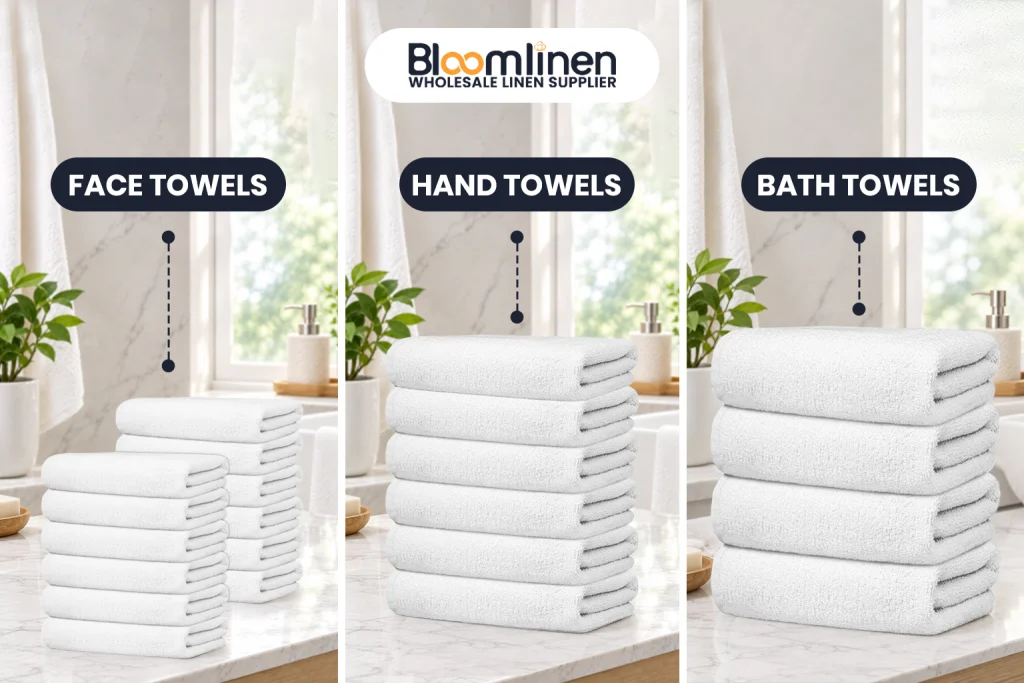
For hotel general managers, directors of housekeeping, and commercial laundry operators, managing bath linens is a delicate balance. On one side stands guest satisfaction: plush, oversized towels that project luxury and quality. On the other sits operational reality: laundry processing weight, thermal drying fuel costs, high-temperature fiber degradation, and shrinkage rates.
Many hospitality properties attempt to simplify procurement by applying a uniform 3-par rule across every linen category. However, treating a face towel the same as a bath towel overlooks critical operational differences. Face towels experience severe chemical staining and high loss rates, while bath towels dominate laundry processing weight and dry-cycle utility costs.
Optimizing hotel linen efficiency requires aligning towel specifications—dimensions, weight, and GSM—with a differential par level strategy designed around real-world loss velocity and laundering overhead.
Commercial Towel Specifications & Par Allocation Matrix
|
Face Towel (Washcloth) |
Hand Towel |
Bath Towel |
|
Size: 12″ x 12″ / 13″ x 13″ |
Size: 15″ x 25″ / 16″ x 27″–30″ |
Size: 27″ x 54″ / 30″ x 60″ |
|
Weight: 1.0 – 1.5 lbs/dz |
Weight: 3.5 – 5.0 lbs/dz |
Weight: 10.5 – 15.0 lbs/dz |
|
Density: 400 – 500 GSM |
Density: 450 – 550 GSM |
Density: 500 – 600 GSM |
|
Risk: Chemical/makeup staining & high loss |
Risk: Vanity dampness & misuse as floor rag |
Risk: High wash weight & longer dry cycles |
|
PAR: 4.0 – 4.5 PAR |
PAR: 3.5 – 4.0 PAR |
PAR: 3.0 – 3.5 PAR |
1. Dimensional Breakdown & Technical Specifications
Evaluating towel categories helps identify the distinct operational role, sizing metrics, and laundering footprint of each item.
A. Face Towels
Measuring 12×12 inches or 13×13 inches (weight range: 1.0–1.5 lbs/dz; standard density: 400–500 GSM), the face towel is the smallest terry item in the guest bathroom suite.
- Functional Role: Personal facial cleansing, makeup removal, and body washing.
- Operational Profile: Face cloths carry the highest discard rate in the building. Because guests frequently use them to remove waterproof cosmetics or wipe down shoes, severe chemical staining (bleach, benzoyl peroxide, makeup) is common. They are also easily misplaced, trapped in duvet covers during stripping, or accidentally discarded by housekeeping during room turns.
B. Hand Towels
Bridging the gap between the face towel vs hand towel, hand towels typically measure 16×28 inches or 16×30 inches (weight range: 3.5–5.0 lbs/dz; standard density: 450–550 GSM).
- Functional Role: Hand drying at the vanity, hair wrapping, and quick touch-ups.
- Operational Profile: Placed directly beside the basin, hand towels experience frequent use per guest stay. In mid-tier to upscale Canadian hotels, hand towels require a balance of softness and structural durability. They face moderate loss rates but undergo high laundering stress due to frequent damp re-folding during stayover room service.
C. Bath Towels
The centerpiece of the terry program, standard commercial bath towels range from 27×54 inches for standard economy to 30×60 inches for premium luxury (weight range: 10.5–15.0 lbs/dz; standard density: 500–600 GSM). Oversized bath sheets (35×68 inches) are generally reserved for luxury suites or spa properties.
- Functional Role: Primary post-shower body drying and coverage.
- Operational Profile: Bath towels account for up to 60–70% of total guest room terry wash weight. While their loss rate is lower than smaller pieces, their unit replacement cost is significantly higher. Evaluating a bath towel vs hand towel or bath towel vs washcloth from a cost perspective requires looking at the total cost per laundering cycle rather than just the initial purchase price.
2. The Operational Mechanics: GSM vs. Commercial Laundry Costs
A common procurement misstep is selecting linens based solely on touch and weight without accounting for commercial laundering dynamics. Grams per Square Meter (GSM) measures fabric density: higher GSM indicates a thicker, more absorbent towel.
- GSM = Weight of Towels in Grams / Area of Towels in Square Meters
- Low-GSM Spectrum (300–400 GSM): Common in economy motels or high-turn fitness facilities. Fast-drying and light, but lacking the plush hand-feel required by mid-scale and luxury guests.
- Commercial Sweet Spot (450–550 GSM): Preferred by the majority of Canadian hotels. A 500 GSM hand towel or bath towel provides excellent absorbency while maintaining reasonable moisture retention levels for industrial tumblers.
- High-GSM Spectrum (600+ GSM): Offers exceptional guest comfort, but dense cotton loops absorb massive amounts of water. In high-volume commercial laundries, drying a 650 GSM bath towel can increase drying times by 25% to 35%, driving up gas or electrical consumption per load.

Shrinkage and Border Seam Integrity
Commercial laundering facilities across Canada process linens at high water temperatures (140°F–160°F / 60°C–71°C) to ensure sanitization. Standard retail towels suffer severe header shrinkage under these conditions, resulting in an unsightly “hourglass” distortion along the decorative border. Commercial-grade terry utilizes fast-drying ring-spun cotton blends with lock-stitched selvage hems and pre-shrunk dobby or cam borders to maintain dimensional stability over 100+ industrial wash cycles.
3. Demystifying Hotel Linen Par Levels
Establishing control over towel inventory begins with understanding Par Levels.
Definition: 1 Par equals the total quantity of linen required to fully outfit every guest room on the property exactly once.
For example, if a 100-room property features 2 double beds per room and specs 4 bath towels, 4 hand towels, and 4 washcloths per room, 1 Par equals 400 bath towels, 400 hand towels, and 400 washcloths.
To calculate the total inventory required across the property:
- Total Pieces Required = Total Room x Items Required Per Room x Target Par Level
The “Cotton Rest Period”
Why is running on a tight 1.5 or 2.0 par dangerous for hotel operations? Beyond the risk of stockouts during peak check-ins, cotton fibers require rest. High-temperature commercial laundering and mechanical tumbler drying strip cotton of its natural moisture. Allowing terry linens to rest for 24 hours in a climate-controlled linen room allows the fibers to absorb ambient atmospheric humidity. This recovery period restores cotton tensile strength and significantly reduces premature fiber tearing.
4. Why Tiered, Differential Par Allocation Works Better
Applying a blanket 3-par allocation across all terry categories often leaves housekeeping short on small items while tying up capital in excess large items. Because loss velocities vary by item size, implementing a Differential Par Strategy protects daily operations.
1. Face Towels & Washcloths: Set Target at 4.0 to 4.5 Par
Washcloths experience the fastest shrinkage rate in any hotel inventory. Guests routinely use face cloths to clean makeup, spillages, or footwear, resulting in permanent staining from acne treatments or shoe polish. Furthermore, washcloths frequently stick to wet shower walls or get caught in bed sheets during express room turns. Maintaining a 4.0 to 4.5 par ensures room attendants never face floor stockouts.
2. Hand Towels: Set Target at 3.5 to 4.0 Par
The comparison between hand towels vs face towels shows that hand towels have a slightly lower loss rate, but they are frequently repurposed by guests and staff as makeshift cleaning rags or floor mats when water splashes near vanity basins. A 3.5 to 4.0 par buffer handles stayover room service needs without straining floor closets.
3. Bath Towels: Set Target at 3.0 to 3.5 Par
Bath towels represent the largest capital investment per dozen. Because guests rarely misplace large bath towels and room attendants track them easily, loss rates remain relatively low. A 3.0 to 3.5 par allocation balances daily rotation, off-premise laundry transit times, and cotton resting periods without over-allocating capital.

OPL vs. Outsourced Laundry Turnaround Impact
- On-Premises Laundry (OPL): Properties processing linens in-house with continuous wash/dry cycles can operate efficiently on the lower end of the differential scale (3.0 Bath / 3.5 Hand / 4.0 Face).
- Outsourced / COG Laundry Services: Properties utilizing off-site commercial laundries with 48-to-72-hour turnarounds must add an additional 0.5 to 1.0 Par across all categories to cover inventory in transit on delivery trucks.
5. Recommended Par Level Benchmarks for Canadian Properties
- Urban Boutique / Business Hotels (On-Premises Laundry): Target 3.0 PAR for Bath Towels, 3.5 PAR for Hand Towels, and 4.0 PAR for Face Towels.
- Full-Service Resorts & Spas (Outsourced / Extended Turnarounds): Target 4.0 PAR for Bath Towels, 4.5 PAR for Hand Towels, and 5.0 PAR for Face Towels.
- Limited-Service Hotels & Motels (On-Premises Laundry): Target 3.0 PAR for Bath Towels, 3.0 PAR for Hand Towels, and 3.5 PAR for Face Towels.
6. Actionable Steps to Reduce PAR Losses and Protect Towel Lifespan
Optimizing par levels goes beyond buying the correct initial stock. It requires protecting that stock from avoidable damage.
- Supply Dedicated Makeup Removal Linens: Introduce dark-colored (typically black or navy) microfiber or terry makeup cloths embroidered with “Makeup.” This simple addition diverts cosmetic stains away from premium white face towels, instantly reducing washcloth discard rates by up to 30%.
- Execute Quarterly Physical Inventories: Relying on purchase invoices to estimate stock levels masks ongoing theft and discard issues. Conduct physical counts every 90 days across all locations simultaneously: linen closets, housekeeping carts, laundry bins, and active guest rooms.
- Establish a Strict Rag Conversion System: Prevent room attendants from using good guest towels for cleaning room surfaces. When a towel suffers minor fraying or unremovable staining, mark the header or cut the towel corner, demoting it to a color-coded rag for engineering or housekeeping use.
How Bloom Linen Meets Canadian Hospitality Specifications
Meeting the balance between guest luxury and commercial durability requires linens engineered specifically for industrial laundering. Bloom Linen supplies Canadian hotels, resorts, and healthcare facilities with high-performance terry products designed to withstand high-temperature wash cycles, chemical sanitization, and rapid tumbler drying.
- Crafted with 100% ring-spun cotton and durable blends featuring lock-stitched selvage hems and pre-shrunk borders to prevent fraying and header distortion.
- Provides consistent wholesale inventory, matching dye lots, and fast nationwide shipping to help properties maintain precise par levels year-round.

Summary
Managing hotel terry inventory effectively isn’t about choosing the lowest-cost item or applying a rigid 3-par rule across every shelf. By matching product dimensions and GSM to operational realities—and structuring par levels around item loss velocity—Canadian hospitality managers can protect guest satisfaction, control thermal laundering costs, and extend the working lifespan of their linen investments.